Background and introduction
Wirral Council is the local authority for the Metropolitan Borough of Wirral, serving a population of approximately 320,200 across a diverse peninsula in North West England. The Wirral is bordered by the River Mersey to the east and the River Dee to the west, with the Irish Sea to the north. It combines industrial heritage and maritime history with coastal villages, country parks, and suburban communities. The area is part of the Liverpool City Region, with strong transport links and economic ties to Liverpool.
The Intelligence Service work in the Corporate Office with policy and strategy and transformation and change teams. They provide insight and business intelligence across council services to drive evidence-based decision making. Performance management is a key area of work ensuring effective oversight and rapid action on areas of underperformance to enable the council to continuously improve delivery of organisational priorities.
The Departmental Management Team (DMT) Insights App
The Insights App was developed to provide assurance to the previous chief executive and his senior leadership team (SLT) that operational performance in all key areas of the council was being delivered and monitored. He requested a monthly report to provide oversight, with exception reporting and reporting on the actions being taken to resolve any issues. This prompted the development of an agile and flexible online App that would provide all information in one place with the ability to interrogate performance alongside other key issues such as risk and finance. Information was to be accessible to all directorates to ensure full council knowledge and oversight.
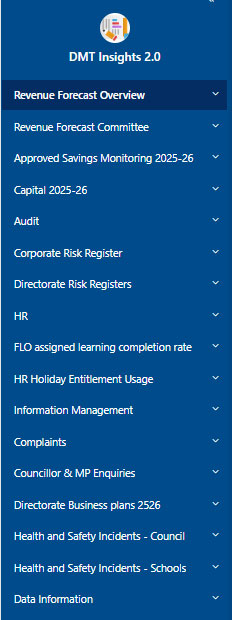
The App deliberately focused on ‘corporate health’ information such as spend, risk, audit and HR data. The full list of areas covered is shown in the image below. It was co-produced with the relevant services to optimise data sources and automation. The use of Power BI interactivity enables the ability to view different directorate results, time periods and data sets and a strong use of visuals. Each of the menu items has a carefully designed number of pages displaying information and data that display information for the whole council or individual directorates and services.
Pages on the App include:
Forecast savings: a breakdown of RAG rated forecast, mitigated savings and variance for each directorate.
Savings delivered: the savings delivered against total budget savings per directorate.
HR information: including sickness absence for the council and by directorate, management of absence performance, and agency staff.
Risk management: showing corporate and directorate risk profiles, with existing and targeted controls and filters for status, scores and RAG rating.
Information management: including targets achieved or not, overdue requests and details for Freedom of Information (FoI), Subject Access Requests and Environmental Impact Requests.
Complaints: number and category of complaints by directorate and percentage achieving target response times.
Audit: provides a summary and detailed information regarding RAG rated risks and recommendations made by internal auditors and delivery of required actions with timescales.
The development of the App was supported by an Organisational Performance Group (OPG) who meet bi-monthly with a remit to review ‘business as usual’ key performance indicators. This cross-council group is made up of senior leaders working collectively to highlight and resolve performance issues. It instigates deep dives into areas of underperformance including work across directorates to share good practice and reports back on progress made following the reviews.
The group reports to SLT and it complements the work of the Corporate Governance Group and the Corporate Change Portfolio Board, which is the gateway for strategic change
programmes. The App content is regularly reviewed, and an iterative process of continuous development is in place to ensure it remains fit for purpose.
The Power BI reporting suite has been set up to leverage automated data refreshes, significantly reducing manual intervention during monthly update cycles. Where feasible, direct integration with source systems via APIs (a type of automated data transfer) enables full automation for selected reports, enhancing both efficiency and reliability.
The initial development phase required substantial effort to identify, validate, and standardise key datasets across multiple systems. This foundational work ensured data integrity and consistency across reports. With the data infrastructure now established, ongoing maintenance is minimal - monthly updates currently require approximately four hours of analyst time. Optimisation efforts are continuing, with a focus on further reducing update time through expanded API connectivity and improved data pipeline design.
Impact
The App is used frequently to spot, understand and investigate underperformance through deep dives so that solutions can be found and performance improved. For example:
- MP enquiries: The council protocol is that all enquiries by MPs must be dealt with within 10 days. It was flagged through the App that the Neighbourhood Services and Regeneration and Place Directorates, who receive over 60 per cent of all enquiries, only answered 51 per cent of enquiries within the deadline during 2023/24. This triggered a pilot in Neighbourhood Services in spring 2024 where support was offered to the owner of the MP enquiry if the enquiry had not been completed by day seven of the 10-day period. This process change and increased focus on accountability triggered a rapid improvement, and the approach was shared through OPG.
- Freedom of Information: The council receives a large number of FoI requests - higher than its neighbouring councils. It has historically struggled to achieve the 85 per cent rate of compliance and attained 75 per cent in 2023/24. The completion of FoI requests is recorded on the App and monitored by OPG who agreed a deep dive in summer 2024. This included in-depth engagement with each directorate to explore reasons for delays as well as a conversation with the Information Commissioners Office (ICO) to seek advice and guidance. It resulted in changes to processes, a new ICT solution, improved capacity in key areas and improved performance across the council in response rates.
Tips
- Sponsorship through the chief executive or another chief officer is crucial to enable whole organisational buy in.
- Take time to co-create, with input and discussions from all relevant departments. This will ensure processes and data flows will work, indicators are relevant and meaningful and tell the right story. Importantly, it will also engage departments and overcome reluctance or resistance for information and performance to be shared.
- Use of Power BI Dataflows centralise transformation logic, allowing multiple reports to use a single, consistent data source. They run in the cloud, not on local processing units, offering greater processing power. Dataflows can feed into each other or output to secure destinations like data lakes or warehouses and are accessible from Power BI or other Fabric tools such as Python.
- Dataflows can be created rapidly by copying existing tables from Power Query and pasting them into a blank Dataflow, saving time and ensuring consistency across reports.
- When incorporating Excel-based data sources from different sources, application of data validation rules and cell protection prevents accidental overwrites and ensures data integrity during refresh cycles.
- Invest time and energy in building trust and effective relationships with officers forming a performance group. Identify a compelling ‘why’ – in this case the importance of spotting early warning signs in order to mitigate and ensure that the council is viable and high performing to serve the public and communities.
Contact details
Dr Nancy Clarkson, Head of Intelligence, Wirral Council
Email: [email protected]