This case study outlines East Sussex County Council’s approach to integrating policy, performance, finance and risk management
Background and introduction
East Sussex County Council (ESCC) covers a largely rural area in South East England, bordered by Kent to the north and east, and Brighton & Hove and West Sussex to the west, with key urban centres along the coast such as Eastbourne and Hastings. As of mid-2023, the county’s population was estimated at approximately 555,500 residents, spread across five districts and boroughs: Eastbourne, Hastings, Lewes, Rother, and Wealden.
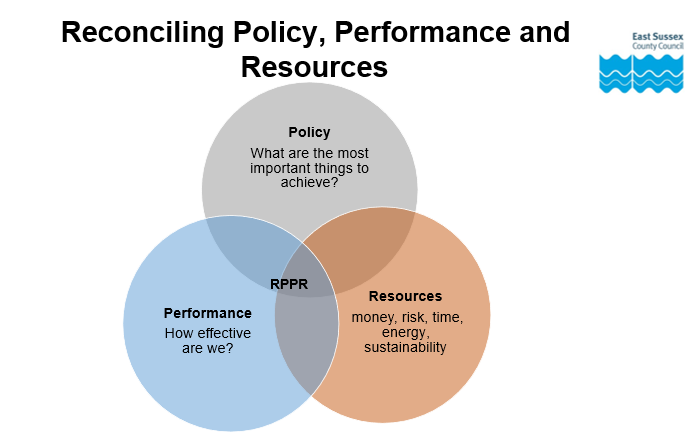
The council’s business planning process - Reconciling Policy, Performance and Resources (RPPR) - applies to the whole council and is supported by a number of teams across the council. Co-ordination of the process is led by the corporate Policy and Performance, Research and Intelligence teams within the Governance Services department and the Finance team in the Business Services department.
The council’s approach to integrating policy, performance, finance and risk management
The RPPR process (which also includes risk) has evolved over the last 20 years and is an established and embedded process and mindset of doing business at ESCC. The RPPR process enables the council to take into account and reconcile all the key information when planning or revising plans or budgets including when there is a need to respond quickly to external shocks. It has fostered collaboration and more careful and holistic decision making. It has become the ‘East Sussex way of doing things’ and is a one council approach. It ensures the council focuses on using all its resources and delivering good value for money, not just on budget and service cuts.
The process is led by the chief executive and Corporate Management Team at officer level and by the Cabinet. It has evolved over time to ensure it continues to reflect the needs of the council. It emphasises horizon scanning and early identification of issues so that these can be mitigated. There is a focus on delivering continuous improvement of services in a way that is both sustainable and best meets the needs of local communities and businesses within current resources.
The process enables a way of collecting and reporting information that draws together considerations of policy (what needs to be achieved?), performance (what performance standards do we need or want to achieve?) and available resources. Resources not only include money, but also staff capacity, physical assets, risks and environmental considerations. This provides a logic and decision-making framework for delivery.
The process starts with the council’s four priority outcomes which articulate the council’s vision for the people of East Sussex and are long-term. Each priority outcome is broken down into several delivery outcomes which are reviewed annually, taking into account a wide evidence base including demographic, economic and environmental data about the council. They also consider internal and partnership intelligence on current and future demands, and horizon scanning of policy and legislative changes. The council plan includes some 50 measures, focused on outcomes. The service level actions needed to achieve the delivery outcomes are included in more detailed portfolio plans which also include performance measures and targets.
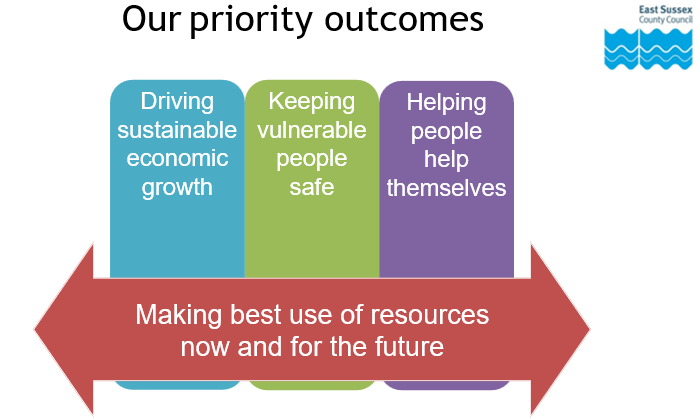
The annual planning process ensures that emerging trends or policy changes are spotted, considered and accommodated in the council’s delivery outcomes. Importantly, annual delivery outcomes include shared commitments with partners recognising that many outcomes can only be achieved through collaboration with others.
Performance is tracked in quarterly reports throughout the year, building on each quarter until the end of the financial year. Performance measures set out in the council plan help ESCC to understand how it delivers against its priority outcomes. Each measure has a challenging yet realistic annual target. Quarterly reports are discussed at Cabinet and Council and are available on the council’s website.
The linkage with finance and risk is through alignment of the medium-term financial plan (MTFP), the capital programme and other resource plans as well as the risk register and the council plan running to the same three-year timescales and the same review points.
Performance, finance and risk information are presented together in quarterly reporting to better support decision making. These reports are supplemented by an annual value for money review.
The RPPR cycle highlights how reporting and decision making is aligned.
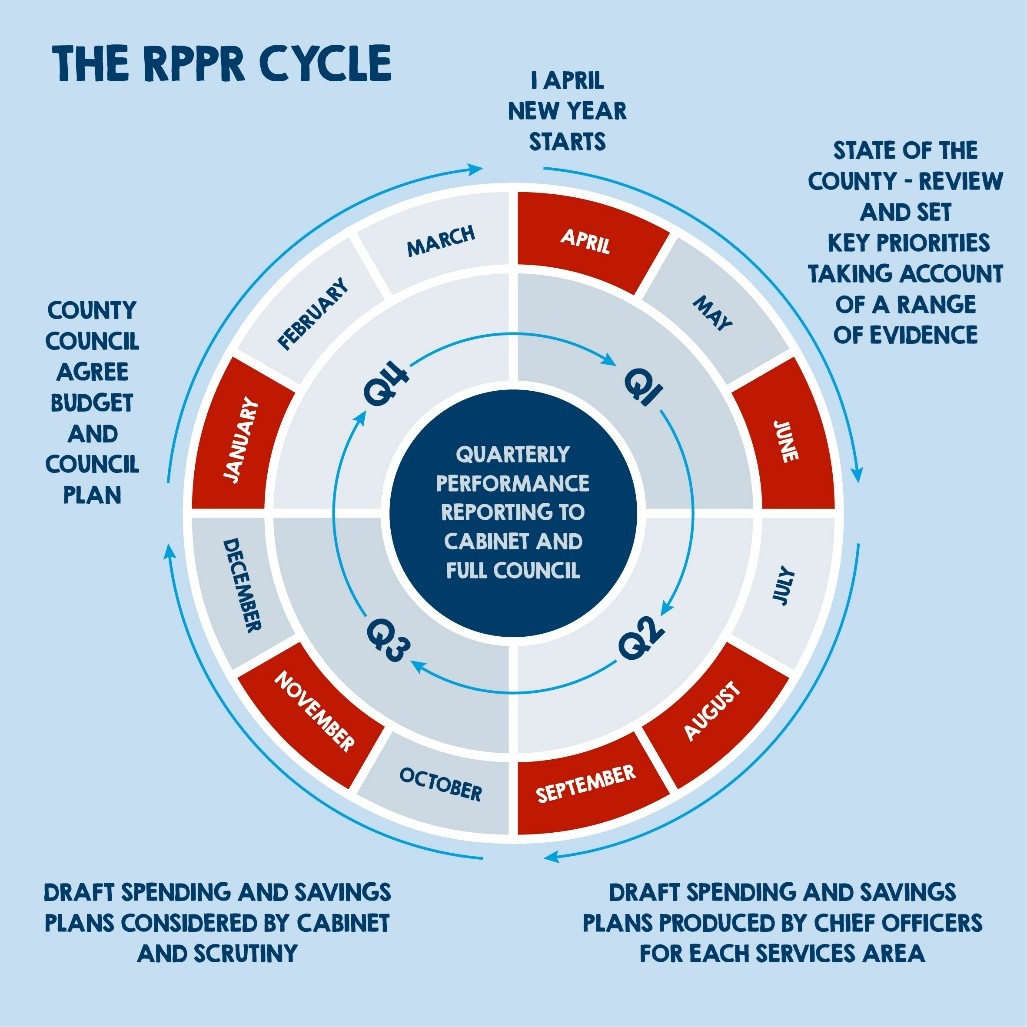
The process has strong member engagement with all reports going to Cabinet and Council and with a Council debate on Cabinet priorities, that is informed by the comprehensive Q4 reporting. Reports are presented by the chief executive, with chief officers and cabinet members taking the lead on providing information on key issues within meetings.
The council’s scrutiny committees review the key business planning and monitoring reports and have input to the RPPR process throughout the year. The council also organises informal briefing sessions for all members on key reports through a series of whole council forums.
ESCC recognises the importance of nurturing and supporting the process itself. The RPPR process is co-ordinated by the heads of policy, performance, research and intelligence and finance, who work together to produce reports. Additional support with disseminating key messages, both internally and externally, is co-ordinated by the head of communications and marketing. The work programme is overseen by an RPPR team, meeting monthly, including the chief executive, the deputy chief executive, the chief operating officer and the chief finance officer.
Regular steers on strategic direction are also provided by the council’s Corporate Management Team. There has been considerable investment in embedding processes with guidance, templates and shared work areas. RPPR is part of member and staff induction and there is an explicit and implicit expectation that as a manager you understand and are responsible for the performance of your service and team.
Relationships and the belief in taking the right decision for the benefit of the whole council are at the heart of the process and make it thrive. As well as the strong internal relationships, the process is supported by long-standing working relationships with key external partners. The business planning cycle includes engagement sessions with partners to ensure they are informed of key developments and that system wide impacts are considered.
Impact
The main impact of RPPR has been that it has enabled the council to be strong, considered and stable in how it deals with external challenge and shocks, such as Covid-19. There is a strong sense that without the RPPR process it would have not been able to navigate financial challenges and demand pressures as effectively and as one council.
The process has ensured that decisions are well considered and take into consideration multiple factors and impacts and gives ESCC a more secure position from which to plan for the longer term. The process itself has brought about a different way of collaboration between colleagues in policy, finance, risk and services – seeking, sharing and reconciling different perspectives as a matter of course. As a result of RPPR the council anticipates challenges and is able to flex in a more planned way, aligning resources to the delivery of changing priorities. Adjustment is nuanced and continuous in line with the council’s commitment to continuous improvement.
Tips
- Leadership from the chief executive, filtering down through the organisation, is crucial in this process.
- The process relies on procedure and mindset. Both need to be nurtured.
- The process is regularly reviewed to ensure it continues to meet the council’s needs.
- Stability in processes and structures helped to embed RPPR in ways of working
Key documents
Council Plan 2025/26 | East Sussex County Council
Our progress against the Council Plan | East Sussex County Council
Cabinet papers on end of year monitoring and State of the County
Council contact
Victoria Beard, Head of Performance, Research and Intelligence [email protected]