North Northamptonshire is a largely rural unitary authority in the East Midlands. It emerged from local government reorganisation (LGR) on 1 April 2021. The council has established a performance and intelligence team, which provides bespoke data analysis and reporting support for adult social care, children’s services, education, and corporate services.
Background and introduction
North Northamptonshire is a largely rural unitary authority in the East Midlands, covering towns such as Kettering, Corby, Wellingborough and East Northamptonshire, with a landscape that mixes market towns, expanding urban centres and extensive countryside. It has a population of around 373,800 residents, characterised by fast growth, a relatively young median age, and a mix of urban and rural communities.
North Northamptonshire Council emerged from local government reorganisation (LGR) on 1 April 2021, when it was formally created as one of two unitary authorities replacing the former county council and seven districts and borough councils.
The council has established a performance and intelligence team of 32 staff, led by a head of service who reports to the director of transformation and strategy. The service is structured into three teams: Public Health Intelligence, Business Analysts and Performance and Intelligence (which includes data analyst and report developer roles).
The performance and intelligence team provide bespoke data analysis and reporting support for adult social care, children’s and education and corporate. Over time, there is an ambition to create a ‘Data Centre of Excellence’ to benefit from a consistent approach to data, performance reporting and modern analytical visualisations and presentation.
The council’s performance management journey since LGR in 2021
Following LGR, the council put a strong emphasis on good governance and getting the basics right, including keeping services running whilst creating a new organisation, and also dealing with the COVID-19 pandemic.
Performance management was seen as an important enabler of this and there was good engagement and support from the corporate leadership team and executive members. The council built on robust approaches to corporate performance management in some of the predecessor authorities, harnessing existing officer talent and knowledge in creating a new team.
Early in the transition, there were high profile monthly reports and the council relied on a simple spreadsheet system that required manual manipulation. Whilst this provided oversight, it soon became clear that without a better data and reporting infrastructure, the ability to understand and examine service data would be limited. As a result, performance monitoring of the key performance indicators (KPIs) this data influenced would remain static, rather than real time and dynamic.
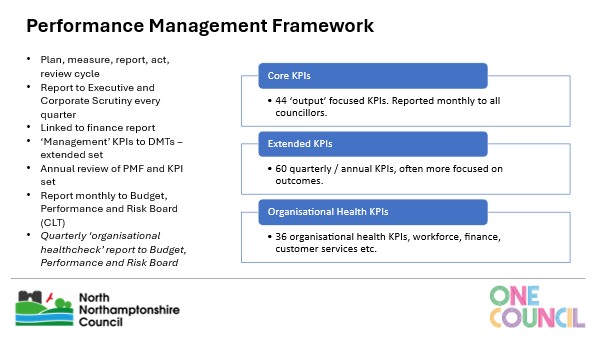
In 2023 the council commenced a transformation of its performance management function. The council’s performance management framework now distinguishes between different types of KPIs (core, extended and organisational health). Over time, there has been increased alignment between performance and financial reporting. For example, the monthly Core KPI report is now integrated within a joint finance and performance report covering the whole council and directorate areas.
Organisational health KPIs are reported quarterly in more depth to a Budget, Performance and Risk meeting of the corporate leadership team with a joined-up discussion of finance and performance.
There are annual reviews of the council’s KPI sets which offers an opportunity to strengthen integrated reporting further.
Moving beyond single KPIs to understand performance
A strong view of the council has been that performance is about understanding and exploring different data sets in real time and in the context of business processes. The use of the LGA data maturity tool guided its thinking about data and informed the council’s data strategy.
Strategic decision-making data in particular has developed more recently, and the performance and intelligence team have a greater focus on the production of needs assessments. This is an area for development, particularly in the context of the new council plan with a shift to outcomes indicators. The creation of BIG50 – a collaboration between the council, voluntary and community organisations, business and education providers – is championing this.
The council has purchased and is implementing modern data infrastructure and is linking this with case management systems to obtain a better understanding of data in business line processes. It started using Power BI as a visualisation tool and purchased the MS Office Fabric platform. A range of data tools are available, with a shift in focus from static performance to more finely grained management information or ‘actionable insights’.
A new approach in adult social care
A recent example is a new financial commitment dashboard for adult social care, which has been built to support the financial management within the service. It includes a visualisation highlighting commitments and individuals receiving support, with a range of view options of the cohort including primary support reason, service component and type, and type of provision.
This dashboard is reviewed at a monthly meeting of the Adult Social Care Finance and Performance Board to manage service and financial performance as well as quality. The performance team present highlights and drive the report to review granular data, drilling into particular service types and historic trends.
Future plans
Longer term, the ambition for the performance management function is to consider the customer journey and how insights and predictions can help in wider strategic commissioning and service planning. For example, what other support may residents who apply for assisted bin collections require now or in the future? Or what does the overlay of data from revenue and benefits, social housing and education say about targeted interventions and preventative measures?
Tips for councils going into LGR
- Recognise it is a journey. Creating processes, systems and a culture in a new council takes time. Dare to leapfrog rather than seeking a common ground between processes, systems and approaches of previous councils.
- Be prepared to re-engineer processes and invest in a data strategy and processes that get the raw data right.
- Focus on skills and train staff in different ways. Revise job descriptions and be realistic about the skills that are required. Engage in apprenticeship programmes. Develop varied and tailored training programmes for staff. This should include attendance at peer networks and the use of on-line learning platforms (for example Data Camp) to allow bespoke training. Set high expectations for staff about training and development, whilst giving them the freedom to tailor it to their own styles, needs and interests.
- Recognise that data analytics in local government is a profession, not an add on. This is a crucial mindset to support people to train and build teams in a way that ensures there are professional pathways.
Contact
Tom Barden, Head of Performance, Intelligence and Partnerships:
[email protected]