An overview of the wider context of biodiversity net gain, including ecosystem services and BNG’s interaction with other environmental mitigation approaches.
Overview
This page includes a selection of resources relevant to local authorities covering how wider environmental considerations interact with the BNG policy. The PAS team aims to continue to update it with useful materials that can be applied to local BNG delivery.
In 2023, the PAS team worked with a number of councils across the country to produce a series of case studies designed to support local government practitioners in their approach to nature recovery and biodiversity net gain. Although most of the example's pre-date mandatory BNG and recent LNRS development, they still offer valuable insights. They explore issues such as natural capital, the role of existing partnerships in securing funding, and the use of digital tools to map new green infrastructure within urban areas. Case studies also examine the links between health, wellbeing, and access to nature, showing how these considerations can be strengthened to benefit local communities.
Biodiversity net gain can also support wider council objectives, including local nature recovery strategies, as well as priorities such as health and wellbeing. In August 2024, Essex County Council and the Essex Local Nature Partnership commissioned a viability assessment of BNG in Essex. The report highlights that offsetting requirements for NSIPs could be aligned with LNRS and could help identify priorities where offsetting investment delivers additional benefits for the local economy, health and wellbeing, recreational access, active travel, and other ecosystem services.
In terms of other forms of habitat creation or enhancements that can contribute towards a developer's biodiversity net gain, government guidance sets out information regarding what schemes can contribute to BNG and what can be counted in full, in part or not at all.
Natural England's Environmental Benefits for Nature tool (BETA)
Developed by Natural England and the University of Oxford with Defra, the Forestry Commission, and the Environment Agency, the Environmental Benefits for Nature Tool (EBNT) can be used to understand the wider benefits arising from BNG. Key highlights of the tool include alignment with the Statutory Biodiversity Metric tool and Green Infrastructure Standards, enhanced landscape integration via the Landscape Character Assessment Database, and better data access through Natural England’s Green Infrastructure mapping portal and a new EBNT QGIS template.
Stacking BNG with district licensing
In November 2025, the PAS team was joined by NatureSpace and West Oxfordshire District Council on a Market in Practice episode covering district licensing and stacking with BNG. The session explored he District Licence (DL) scheme and the Newt Conservation Partnership’s role as both delivery partners and a Responsible Body. It will provide practical insight into how stacking DL with BNG works, including collaboration with Local Planning Authorities (LPAs) and alignment with wider conservation strategies.
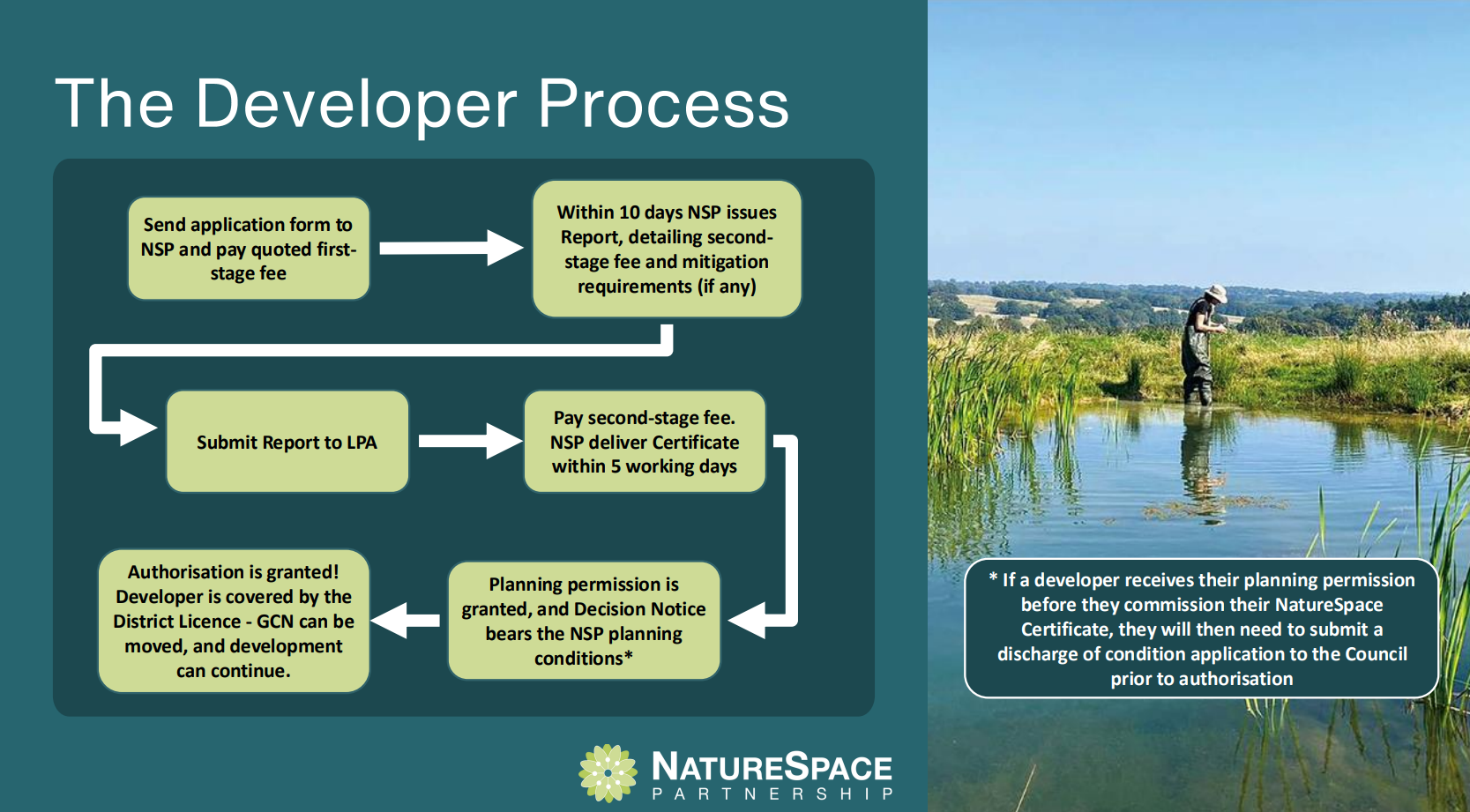
Stacking BNG with District Licensing is an approach that allows applicants to use the same habitat creation to meet two separate obligations: compensating for impacts on great crested newts (Triturus cristatus) under the District Licence and contributing toward their Biodiversity Net Gain requirements. When a developer pays for habitat creation through the District Licensing scheme, that habitat can also count toward their BNG targets, up to the point of achieving No Net Loss. This dual use of land is referred to as “stacking.” However, to comply with DEFRA’s additionality rules, at least 10% of a development’s BNG requirement must come from standalone BNG habitat, which NatureSpace also provides through its stacked scheme.
The process begins at pre-application stage, where developers can apply to NatureSpace for both District Licensing and BNG at the same time. NatureSpace works closely with the Newt Conservation Partnership (NCP), a Responsible Body, to secure gain sites under Conservation Covenants. A draft Biodiversity Net Gain report is issued, which developers can submit to the LPAs alongside other BNG documents to demonstrate off-site considerations.
During the application process, the District Licensing process remains unchanged but feeds into the BNG process. NatureSpace collaborates with developers, ecologists, and case officers to adjust packages if development proposals change. Once the District Licence fee is paid in full, savings are applied to the BNG price.
Post-permission, when the full balance is received, the reserved BNG units are sold and are allocated to the development via the Gain Site Register. NatureSpace then issues a final BNG report for inclusion in the developer’s discharge of condition submission to the LPA. Throughout the process, NatureSpace provides ongoing support, high-quality habitat banking, and reporting to LPAs for biodiversity duty compliance and LNRS priorities. A recording of the session with NatureSpace and West Oxfordshire District Council can be found below.
Historic Environment (Oxford Archaeology) – Better BNG for the Past, Present and Future
In December 2024, Dr Nick Overton of Oxford Archaeology, the lead researcher on this Historic England–funded project, presented an initial overview of research examining off-site BNG and the historic environment.
The project explores the extent to which the historic environment is considered in the design and implementation of off-site BNG schemes. It also seeks to improve understanding of the relationship between habitat restoration and creation initiatives and historic assets. In addition, the research aims to identify relevant resources and guidance to support professionals without a heritage background, helping them to recognise and incorporate historic environment considerations when designing off-site BNG schemes. A recording of Nick’s project overview, along with background information shared with the network, is available to view below.
In January 2026, Nick joined a PAS BNG drop-in session for LPA practitioners to present the findings of this research. The project engaged a wide range of stakeholders and received more than 160 responses.
Key findings highlighted that in 65% of cases, historic environment professionals were not consulted, and only 8% of respondents said that the historic environment was always a consideration in off-site BNG design. Nick also outlined several challenges identified through the research, including siloed working practices and a lack of clear guidance. Notably, just 4% of respondents felt that existing guidance adequately addressed historic environment considerations in relation to off-site BNG.
The session also presented evidence of habitat creation practices and species introductions that may cause harm to the historic environment, alongside examples of opportunities where historic assets can positively support habitat and species outcomes.
A recording of Nick’s presentation on the research findings is available to view below. A free copy of the project report can also be accessed here, which includes a detailed review of the findings alongside a range of resources addressing both impacts and opportunities relating to historic assets.
Integrating green infrastructure
Natural England’s Green Infrastructure Standards for England note that incorporating common green infrastructure features such as green roofs, green walls and sustainable urban drainage systems (SuDS) within developments can help meet BNG requirements. Urban Design Learning (UDL) has worked with the London Boroughs of Camden and Islington to explore opportunities on highways land to enhance access to nature and increase the benefits associated with green infrastructure. Their work demonstrates how these interventions can improve quality of life, address inequalities, and support wider ecosystem services when integrated from the outset.
UDL has co-developed a range of resources offering design guidance and best-practice recommendations. Alongside this, they regularly share insights from their sessions, covering topics across green and blue infrastructure. These updates highlight key considerations for scheme design, including health and wellbeing, the circular economy, and related priorities.
UDL also provides a collection of design codes from various councils. For those working on BNG and/or the Urban Greening Factor (UGF), these documents offer a strong foundation for understanding additional opportunities to support BNG delivery in a local context. For example, Section 5 - Nature of Elmbridge Borough Council’s Design Code includes guidance on urban greening, trees and street gardening, flood risk, SuDS, and enhancements to urban riverside environments, alongside BNG.
The Urban Greening Factor, as set out in the February 2023 London Plan Guidance, is a mechanism intended to help meet wider London Plan policy requirements, including Policy G6 on biodiversity and access to nature. Section 2.4 explains how UGF can contribute to delivering BNG and provides further support through a dedicated design guide for applying UGF to BNG.
DISCLAIMER: The PAS team updates these pages regularly to reflect current guidance on biodiversity net gain as best we can. Our goal is to provide accurate, timely information to support local planning authorities. If you are from a local authority and have any questions about the content or need further information, please contact us at [email protected]. This page was last updated on 10/04/25.