This research document provides an evidence‑based overview of the lived experiences of military‑connected children and families, including the impact of mobility, deployment, separation and service‑related stress. It brings together research, policy and practice insights to help Family Hubs develop informed, military‑aware approaches that improve stability, wellbeing and outcomes for families affected by service life.
Family Hubs, supporting Military Families
Supporting military families requires an approach that is both proactive and deeply compassionate, recognising the unique challenges that come with service life. Family Hubs play a vital role in providing accessible, coordinated, and child‑centred support for families navigating deployments, relocations, transitions, and the emotional impact of military life. This toolkit has been designed to help professionals understand those needs, strengthen partnerships with military‑connected communities, and ensure every family receives timely, consistent, and high‑quality support. By working together, we can create a welcoming environment where military families feel understood, valued, and fully included.
The new Best Start Family Hubs and Healthy Babies Guidance
Minimum expectation :
Staff understand families’ needs and are able to sensitively discuss a range of issues with them as appropriate. Examples of services where there is an expectation to do this include the sections on supporting Armed Forces families, school attendance and children affected by parent/carer imprisonment
And the ‘go further’option:
The establishment of a military champion in every hub – this could be linked into local authority commitments already in place through the Armed Forces Covenant, OGD Covenant commitments or relate to the April 2025 joint MOD/DfE guidance – ‘Service Pupils in Schools: Non-Statutory guidance’, where LAs are asked to consider developing a Service Pupil Champion role.
Further information is available in the Guidance and Appendices.
Best Start Family Hubs and Healthy Babies: guidance for local authorities - GOV.UK
When we refer to military families we are including:
- British Army
- Royal Navy
- Marines
- Royal Air Force
- Veterans
- Reservists
‘While many armed forces families enjoy healthy lives, the pressures of deployment, periods of separation, and social isolation from family and friends can have a negative impact on the health and well-being of the family. Should a serviceperson be injured on duty, this can lead to additional caring responsibilities, including coping with changes to someone’s physical and/or mental health. For those who make the ultimate sacrifice for their country, it is our duty to ensure their families are supported. ’ Armed Forces Family Strategy 2022-32
The Armed Forces Continuous Attitude Survey3 (AFCAS) provides data on service personnel reporting on their family situation, including demographic information on their partners and children.
AFCAS estimates there are around 121,600 Children from armed forces families (aged 0-17) in total
- Service personnel with dependent children 51%
- Service personnel with no children 49%
- Single-parent families 3%
- Service personnel with…
- 1 or more child under 5 24%
- 1 or more child between 5 and 17 35%
- 1 or more child over 18 7%
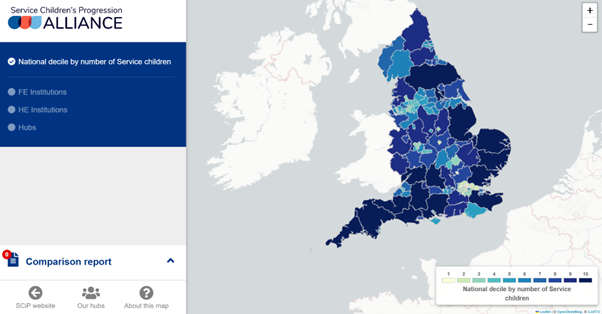
The Service Children’s Progression Alliance (SciP) have an interactive map that allows LAs to see how many service children are in their area
Why Children and Families in Military Families Need Support
Military children and families need support because their lives involve unusual levels of transition, separation, emotional stress, and social disruption. Targeted support helps protect children’s wellbeing, maintain family stability, and strengthen resilience.
1. Frequent Relocation: Military families often move every 2–3 years. This can mean:
- Changing schools repeatedly
- Difficulty forming long‑term friendships
- Interrupted access to health or specialist services
- Stress for parents navigating new communities and systems
Frequent moves can affect children’s sense of stability and belonging.
2. Parental Deployment and Long Separation: When a parent is deployed overseas (sometimes in dangerous situations), children may experience:
- Anxiety, fear or worry about their parent’s safety
- Changes in behaviour, sleep, or school performance
- Emotional distress due to missing their parent
The remaining parent or carer may shoulder full childcare responsibilities, increasing pressure on the whole family.
3. Emotional Stress and Mental Health Pressures: Serving personnel can face traumatic situations. This can impact family life through:
- Parental stress or emotional withdrawal
- Difficulty reintegrating after deployment
- Challenges adapting to changes in family roles
Children may need support to manage their own emotional responses and maintain secure relationships.
4. Social Isolation: Military families may live on bases or in communities where people come and go frequently. This can lead to:
- Feelings of isolation for children and parents
- Limited informal support networks (extended family, close friends)
- Difficulty accessing consistent community resources
Support services help to build stability and connection.
5. Educational Challenges :Schools may need to understand the context of:
- Interrupted learning
- Emotional impacts of deployment
- Behaviour changes linked to stress
- Differences in curriculum between regions or countries
Support ensures children are not disadvantaged in their learning and development.
6. Reintegration After Deployment: When the deployed parent returns:
- Family roles shift again
- Children may need time to adjust
- Parents may experience hidden injuries (physical or psychological)
Families often need support to navigate these transitions without conflict or confusion.
7. Financial and Practical Pressures: While many military families are stable, some face:
- Increased costs associated with moving
- Challenges maintaining employment for the non‑serving parent
- Limited access to childcare or transportation
Practical support helps reduce stress and increase resilience.
The Armed Forces Covenant
The Armed Forces Covenant is a promise that together we acknowledge and understand that those who serve or have served in the Armed Forces, and their families, including the bereaved, should be treated with fairness and respect in the communities, economy, and society they serve with their lives.
Its two principles are that, recognising the unique obligations of, and sacrifices made by, the Armed Forces:
- Those who serve in the Armed Forces, whether Regular or Reserve, those who have served in the past, and their families, should face no disadvantage compared to other citizens in the provision of public and commercial services.
- Special consideration is appropriate in some cases, especially for those who have given most such as the injured and the bereaved.
The Covenant Legal Duty is a legal obligation on certain public bodies to have due regard to the Covenant principles when carrying out certain functions in healthcare, education, and housing.
The public bodies subject to this Legal Duty include local authorities, governing bodies of certain state-funded schools, and various NHS bodies.
There is an introductory module to the Armed Forces Covenant and community, which is available on The Armed Forces Covenant Fund Trust’s website. This brief module forms a starting point for understanding the Covenant etc. Covenant Duty explained – Health - Armed Forces Covenant Fund Trust
The Cycle of Deployment
The Navy Families Federation have produced a useful guide on the cycle of deployment for Royal Navy and Marines but the contents work across all the military families.
Deployments & Weekending Support | Advice Naval Families
The Emotional Cycle of Deployment is a model that was developed for naval families by Kathleen Vestal Logan in 1987 and published in Proceedings Magazine1 . While times have moved on deployments can be short or long and are often extended, it is still a helpful tool in understanding and explaining changes in feelings and behaviour resulting from deployment. There will be individual differences in how people feel, and each deployment will be different.
It includes a section on Feelings and Behaviours for Babies, Toddlers and Pre-schoolers during the Stages of the Deployment Cycle and others for primary and teenagers, alongside strategies and practical ideas that may help.
Benefits of being a child in a military family
As we have already stated, being a military child can have added pressures however for some children it brings real opportunities to thrive. Military children are highly resilient, adaptable, and able to flourish through the challenges of service life—such as frequent relocations and parental deployment—when provided with strong nurturing, understanding, and structured support. These children, often called "dandelion children," thrive by developing extraordinary emotional intelligence, maturity, and a strong sense of community.
Schools: Using tools like the Thriving Lives Toolkit helps schools provide targeted support for Service children.
Military life can be demanding, but it also fosters a unique upbringing characterized by pride, courage, and a unique worldview.
How family hubs can support military families
1. Providing a Single, Local Access Point for Support
Family Hubs are designed as central, easily accessible places that bring multiple services together for families.
The DfE's Family Hub guidance describes hubs as a network that “joins up and enhances services for families with children of all ages” and lists core services from early years support, mental health, housing, and wider family help.
For military families, who often relocate, this “one‑stop” model mirrors the MOD’s own Families Hub digital platform, which signposts to support with housing, health, childcare, finance, SEND, and partner employment.
Local Family Hubs can complement this by helping families navigate local systems quickly after a move.
2. Supporting Children with Education, Transitions, and Emotional Wellbeing
Military children experience frequent school transitions and stress linked to deployment.
Family Hubs are expected to deliver parenting support, early childhood education support, early language/home learning programmes, and targeted whole‑family help.
In addition, national guidance recognises the needs of Service children and includes:
- Childcare for Service children (GOV.UK guidance, 2026)
- Education and Service Pupil Premium (SPP) support
- Local Authority Partnership guidance (MODLAP) to help LAs plan around Service families’ needs
Family Hubs can directly support transitions by:
- Liaising with schools to share relevant context
- Running emotional wellbeing groups
- Offering targeted support for children struggling with deployment‑related anxiety
3. Supporting Parental Mental Health and Relationship Stability
Military life can bring pressures such as deployment stress, reintegration challenges, and periods of solo parenting.
Family Hubs are expected to offer:
- Parent–infant relationship and perinatal mental health support
- Mental health services for parents
- Support for reducing parental conflict These align well with the MOD’s recognition that separation and operational demands can create emotional strain.
Family Hubs can therefore offer space for:
- Counselling or wellbeing sessions
- Peer support groups for military partners
- Help for parents managing stress during pre‑ and post‑deployment period
4. Wraparound Support for Practical Challenges (Housing, Finance, Benefits, Childcare)
The MOD’s Families Hub outlines support needs around housing, finance, childcare, SEND, and transition to civilian life.
Family Hubs provide:
- Welfare and debt advice
- Housing support
- Access to financial guidance
- Information on childcare, tax‑free childcare, and early years provision
This practical offer is crucial for families who may:
- Need rapid housing advice during relocation
- Struggle financially during periods of deployment
- Need support accessing childcare in a new area
5. Providing Community, Belonging, and Reducing Isolation
Frequent moves and living away from extended family can isolate military families.
Family Hubs provide:
- Universal activities
- Parenting groups
- Youth services
- Volunteer‑led and peer‑support networks
This helps families build new connections quickly—reducing isolation and creating supportive communities around children.
6. Working in Partnership with MOD and Local Military Welfare Agencies
MOD welfare services (e.g., Army HIVE Information Centres, unit welfare teams) provide relocation guidance, accommodation information, deployment support and local area information.
Family Hubs can:
- Develop joint pathways with HIVE, Veterans’ services, and military charities
- Share local childcare, SEND, or school information with families newly posted
- Ensure assessments and support plans follow families through moves
- Work with their Local SCiP Alliance’s regional hub
This creates a seamless experience between civilian and military systems.
The SCiP Alliance's network of regional hubs brings together partnerships which connect stakeholders so that they can:
- Enable new and better collaborations
- Facilitate communication
- Build capacity and capability
- Reach out to new stakeholders
- Communicate with, contribute to and draw from the SCiP Alliance Practice Group and Strategy Board
- Share and respond collectively to:
- Effective practice
- Challenges
- Ideas
- Priorities
- Questions
Family Hub Champion
The Ministry of Defence has produced an Early Childhood Armed Forces Champion for Early Years Settings (see download) and Alex Barker MP has called for all Family Hubs to have a champion.
The role might include:
- Be the point of contact between all Service families and the family Hub
- Be the link between the family hub and the military Command, including the MOD’s Welfare teams.
- Facilitate communications with Service families, and where appropriate with the Serving parent.
- Provide support for the parent left at home, particularly during deployments.
- Support the development of training for other family hub staff and other professionals who work with young Service children and their families.
- Liaise with local authorities to facilitate appropriate SEND support as required.
- Liaise with childcare provision and/or schools to ensure children are given s successful transition.
Alex Baker MP for Aldershot and Farnborough has written a report :
‘Forces Families Deserve the Best Start , How we can strengthen Best Start Family Hubs to meet the needs of our military community.’
Forces Families deserve the Best Start
Her report makes the following key recommendations
- Standardise the question 'Are you from a military family?' across all Family Hubs.
- Introduce universal training for Family Hub staff on the emotional cycle of deployment, transitions, trauma, and SEND.
- Establish a military champion in every Hub.
- Ensure flexible and hybrid services that account for relocation, unpredictable schedules, and dispersed families (where the serving person lives apart from other family members and returns only at weekends or during leave).
- Embed trusted military charities and peer-led support within Hubs.
- Support continuity of care for children with additional needs through portable EHCPs.
- Co-produce culturally sensitive services with Commonwealth military families.
- Plan for surge demand during deployments, with resourcing to match.
- Engage with the key annual events such as Month of the Military child in April, Armed Forces week in June and Remembrance in November, sharing how you celebrate, with the Armed Forces Champion’s network.
- Signpost to other support services to support the Service family.
Bereavement
When a parent dies, the impact on their child is significant. When that parent served in the Armed Forces, the impact is even greater with children often feeling they’ve lost their connection to the military community (Scotty’s Little Soldiers)
Bereavement support for military families includes specialised services for spouses, partners, and children coping with the loss of service personnel, covering combat, accidents, or illness. Key support organizations like SSAFA, Winston's Wish, and Scotty's Little Soldiers offer peer support, counselling, and practical advice to navigate complex grief, including cases of suicide.
Armed Forces Bereavement Scholarship Scheme (AFBSS) - for the bereaved children of service personnel
The AFBSS was set up by the UK government to support the children of service personnel whose death was attributable to service. The scheme will enable them to progress into the post-16 and higher education.
Find out more about AFBSS eligibility, amounts awarded and overseas applications on GOV.UK.
The Service Children’s Progression (SciP) Alliance
The SCiP Alliance Hub Network | SCiP Alliance
The SCiP Alliance also have a toolkit ‘Thriving Lives Toolkit’ It is underpinned by rigorous research and thoroughly tested in schools and provides them with a framework of 7 principles through which to reflect on their practice and a 3-tier set of CPD resources. The resources in this toolkit have been developed in collaboration with a range of partners across the UK, and consist of:
- an introductory animation;
- a detailed resource introducing the evidence base, what schools can do to support their Service children and who can help and;
- school case studies.
SCiP Alliance Toolkit
The Alliance are currently developing an Early Years toolkit which will hopefully be published Summer 2026.
Summary
Family Hubs can support military families by offering:
✓ A local “one‑stop shop” complementing the MOD’s digital Families Hub
✓ Emotional and educational support for children experiencing transitions
✓ Mental health and relationship support for parents
✓ Practical help with finance, housing, childcare, and SEND
✓ Community‑building activities to reduce isolation
✓ Joined‑up working with military welfare structures
Practical tips:
- If you are near to a military base you could approach them to discuss delivering services within their community centres. For example a stay and play session or a coffee morning. You could deliver some after school sessions for the older children.
- Some military partners don’t drive so having it on the camp makes it much more accessible and as it is in their community feel a safe space.
- Planning ahead for the delivery of these sessions will take time as you are likely to need clearance to be on the camp.
- If a family have been attending your Family Hub but share with you that they are moving to a new area, offer to do a ‘warm handover’. With their permission you can do an introduction to their new hub. Agree with the family how much information they would like you to share. The new hub can then reach out to the family on arrival, show them around the new family hub and explain what services are available, how to book etc and offer any support they may require.
Together, these elements respond directly to the unique pressures of military life and help improve family resilience and stability
Appendix 1
Impact of Military Life on Children Aged 0–5
Children in the early years are especially sensitive to change, separation, and the emotional climate of the home. Research shows that the pressures of military life—deployment, frequent moves, changes in routines, and parental stress—can have significant effects on social, emotional, cognitive and relational development in the 0–5 age range.
1. Impact of Deployment on Babies and Toddlers
Emotional and Behavioural Reactions
Studies show that young children often display distress during deployment and when a parent returns after long absences.
Common responses include:
- Sleep disturbance
- Clinginess
- Regressive behaviours (e.g., toileting, language)
- Anxiety around separation
Research demonstrates that younger children experience increased emotional and behavioural difficulties during a parent’s deployment compared with their civilian peers.
Attachment Disruption
Young children (0–5) rely heavily on consistent caregiving.
When a serving parent leaves for 6–12 months, infants may:
- Lose familiarity with the absent parent
- Need to “rebuild” attachment bonds after return
- Show fear or avoidance during reintegration
Early childhood professionals note that re‑establishing relationships post‑deployment is often emotionally challenging for babies and toddlers.
2. Cognitive and Developmental Impacts
A study of preschool children found that those with a deployed parent were twice as likely to fail cognitive or social‑emotional developmental screens compared to those without deployed parents.
Areas most affected:
- Gross motor skills
- Personal‑social skills
- Early learning engagement
Length of deployment was correlated with increased developmental risks, though not always statistically significant.
3. Impact of High Mobility and Frequent Moves
Military families typically relocate every 2–3 years, affecting stability and access to early years services.
Frequent moves lead to:
- Changes in nurseries and childcare
- Loss of peer relationships
- Reduced continuity of health records (HV, GP, SEND) [raf-ff.org.uk]
Early years specialists emphasise that frequent moves can disrupt routines and create anxiety, making it harder for young children to settle and form secure relationships with caregivers. [raf-ff.org.uk]
Mobility is linked to:
- Social and emotional stress
- Difficulties forming early friendships
- Disruptions to early learning progression [scipalliance.org]
Appendix 2: Best Start Family Hubs and Healthy babies Guidance
Armed Forces families
Minimum expectations
• Staff in the BSFH are aware of the challenges that Armed Forces and Veteran families can face e.g. cumulative impact of mobility, separation, deployment, life after service and bereavement and are confident in discussing these sensitively with families where appropriate. (Further detail is set out in the The Armed Forces Covenant Statutory guidance).
• Staff in the BSFH signpost families to support services where appropriate, including:
- The MOD’s Education Advisory Team (able to advise on a range of educational matters including SEND, school admission/appeals, school
- transition) – EAT contact details to be found on the Defence Children Services website Assigned in the UK.
- Armed Forces Family Federations, each service has a dedicated Families
- Federation who are able to provide support and guidance across a range of
- areas including education.
- Army Families Federation (AFF): aff.org.uk
- Naval Families Federation (NFF): nff.org.uk
- RAF Families Federation (RAF FF): raf-ff.org.uk
• Staff in the BSFH to be aware of joint MOD/DfE guidance ‘Service pupils in Schools: Non-Statutory guidance’ (April 2025) to help state-funded schools and local authorities in England to understand and address the needs of Service pupils in schools. The guidance can be found at: Service pupils in schools-non statutory guidance.
• Staff in the BSFH to be aware of whether their local authority is a member of the MOD Local Authority Partnership (MODLAP) and agreed principles when supporting the school transition of Service children with SEND. ‘Go further’ options
• The establishment of a military champion in every hub – this could be linked into local authority commitments already in place through the Armed Forces Covenant, OGD Covenant commitments or relate to the April 2025 joint MOD/DfE guidance – ‘Service Pupils in Schools: Non-Statutory guidance’, where LAs are asked to consider developing a Service Pupil Champion role